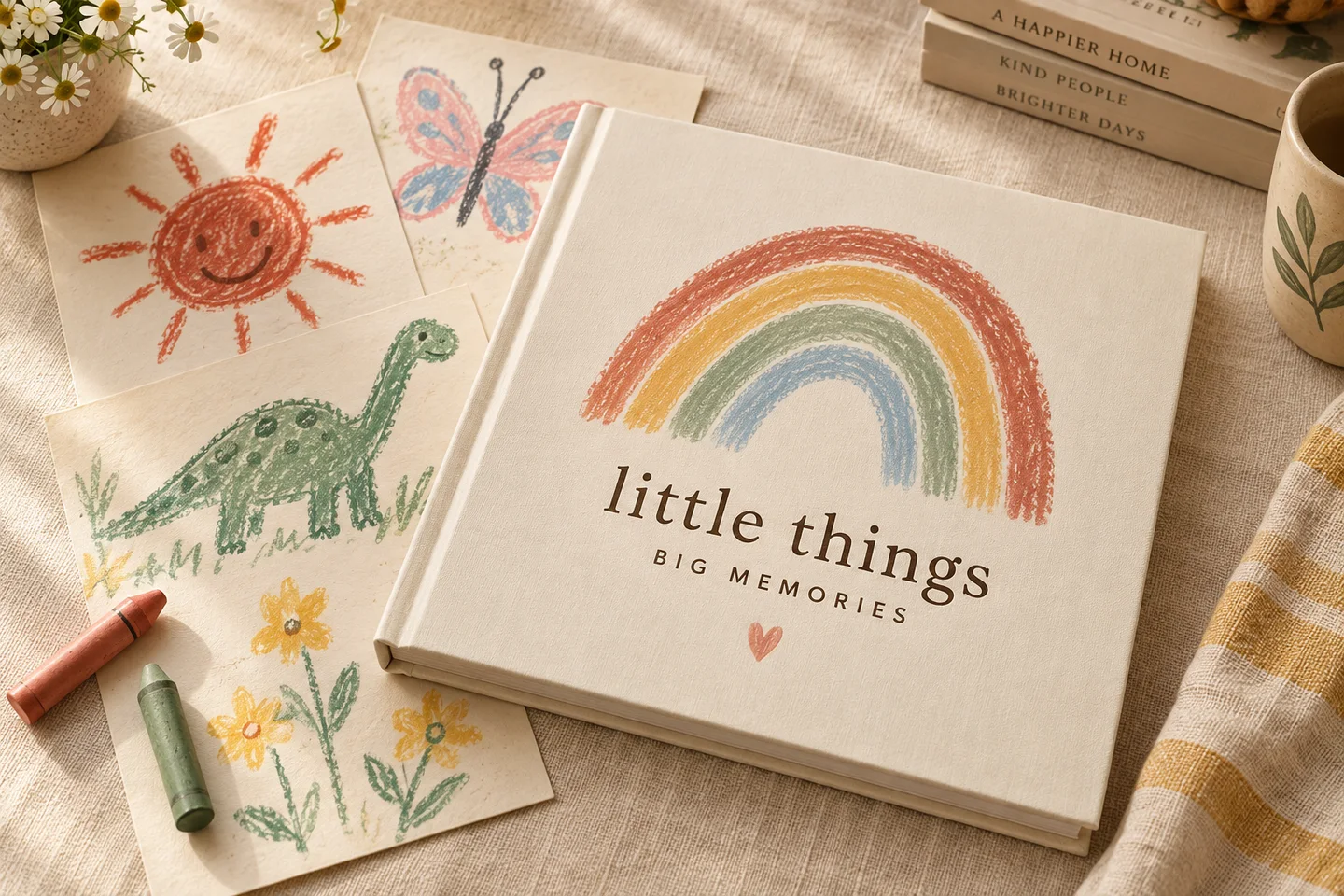
At the end of a school year, many kinds of material arrive together: art folders, certificates, early long-form writing, class photographs, small notes and work whose meaning is easy to miss without an explanation. An art or school-year book can make a clear memory from it—as long as it does not become a performance report.
The useful question is not “What was best?” but “What tells the story of this year?” An imperfect drawing may reveal a new friendship, favourite subject or brave idea more clearly than a marked exercise.
Define one period
Begin with one school year rather than the whole of childhood. A narrow frame makes selection and captioning easier. Gather everything first without deciding immediately. Useful groups include:
- free drawing and painting;
- work from art lessons;
- memorable writing or topic work;
- class and event photographs;
- certificates or report covers, where you have permission to preserve them;
- one short note about an important event.
Where class photographs or work includes other children’s names, confirm that private processing and family printing are permitted. A private book is not permission to publish.
Choose variety, not grades
Look for different materials, subjects and points in the year. Thirty pieces can show a full year better than a hundred tiny thumbnails. A strong selection might contain:
- the first work of the year;
- a recurring character;
- an experiment with paint or printmaking;
- something the child talked about at length;
- a collaborative piece where the rights are clear;
- later work that shows visible change.
Grades, assumed ability and school performance should never be inferred automatically from images or documents. If a report cover belongs in the book, it is a visual memory—not a data source for assessment.
Photograph large and fragile work first
Large sheets and loose chalk work can deteriorate during repeated sorting. Photograph them before moving the whole folder several times. Place the work flat, use indirect light and keep every edge visible. A second angled view can help with texture.
How to photograph children’s artwork with your phone covers focus, perspective and glare. A good automated check should show individual problem images and never reset a whole selection because one file failed.
Use a chapter structure that does not overcomplicate things
The book can remain chronological or use a few genuine themes:
- Seasons: autumn, winter, spring and summer.
- Material: drawing, painting, printing and making.
- The child’s subjects: animals, places, stories and imagination.
- Upload order: entirely valid when categories create unnecessary work.
Do not force every piece into a category. A work may stand on its own. A simple yearly book may need only a title page, a short introduction, the work and one closing page.
Captions are useful, not compulsory
Age, class, date, title and material may enrich a page. Use only visible information or details supplied by the family. Software should not turn handwriting into a presumed full identity, visual style into an age or a photograph into an assumed school.
One short question often provides the best text: “What should someone know about this picture?” Record the answer verbatim or very close to it. Some works can remain uncaptioned.
Design for the actual proportions
Children’s art does not follow one page ratio. A landscape piece should not be enlarged until its top and bottom disappear. A long, narrow work may need a page with a wide border. Two smaller pieces can share a page when they genuinely belong together.
A professional print package checks page size, effective resolution, safety margins, embedded fonts, missing images and overflowing text. A hardcover also needs the right page count, cover treatment and provider-calculated spine. An arbitrary PDF with “print” in its filename is not enough.
Close the year with a small reflection
A final page might include three brief, optional details:
- a favourite material;
- a subject drawn often;
- one event the child remembers.
Avoid automatically written claims about personality or development. “She became more confident this year” belongs only when the family chooses those words. A book can document without diagnosing.
Frequently asked questions
Do class photographs belong in an art book?
They can work as a quiet chapter marker where private use is permitted. People should never be automatically identified, named or analysed for personal attributes.
How many pages does a yearly book need?
That depends on the print product and selection. Hardcover photo books often have a minimum page count and require an even number of pages. Include title and closing pages without adding filler simply to make the book longer.
Can I combine several school years later?
Yes. Keep one checked selection and basic details for each year. These can later become clear yearly chapters. Versioned layouts help an existing book remain reproducible.
For a year centred on drawings, choose a Kids’ Art Book. Start with a free preview of up to three artworks. A hardcover needs at least ten suitable artworks. Keep photographs and certificates separately in your private school archive.