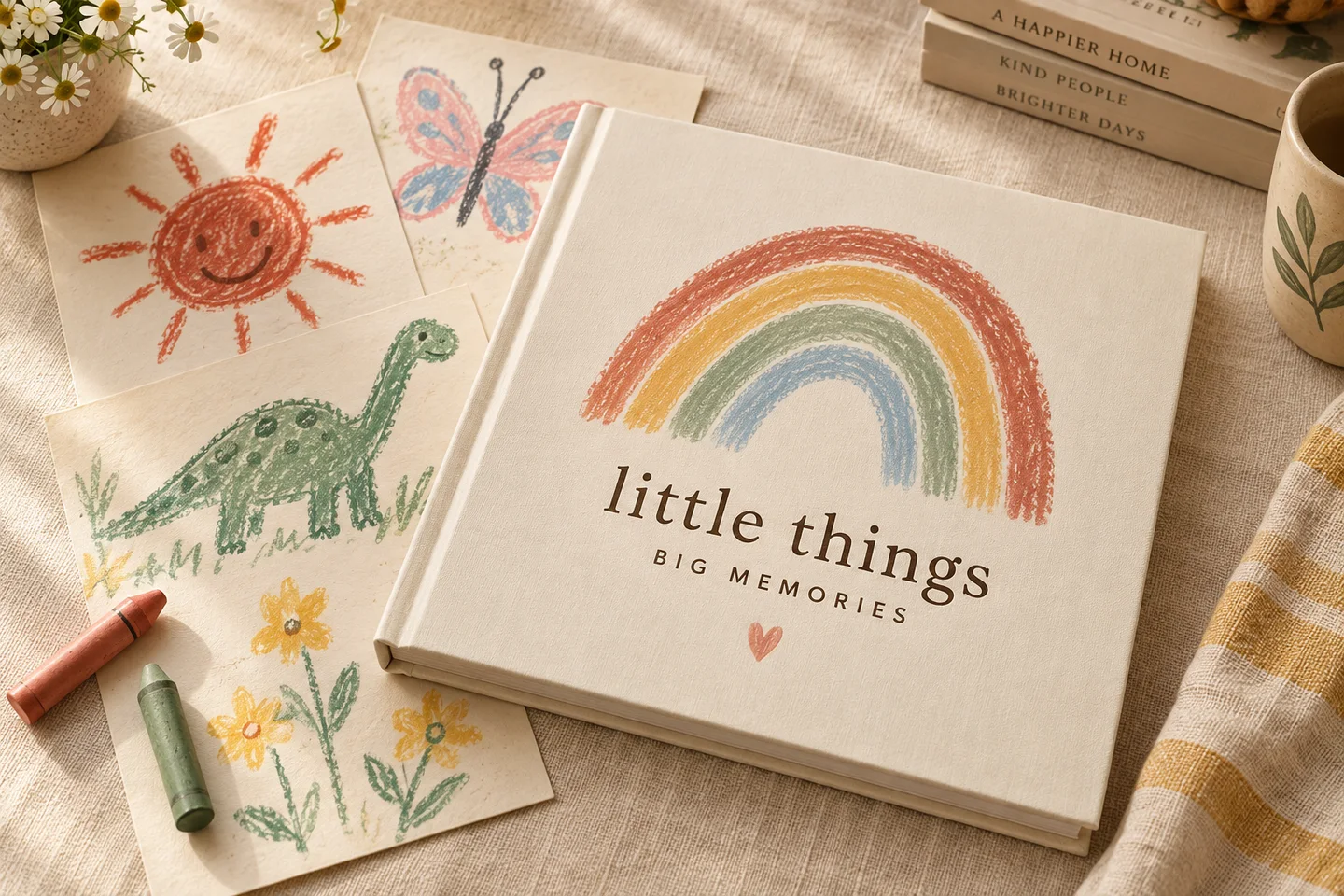
A good gift for grandparents does not need to announce how personal it is. It can simply come from real family life: drawings that would otherwise live across folders and drawers, carefully selected, arranged and bound into a book.
Children’s art works especially well because it does not need to be staged for the occasion. The subjects, unexpected colours, early letters and small explanations already exist. Good design does not add artificial meaning; it gives the work room.
Give the book one clear idea
A simple frame makes choosing easier:
- “A year in pictures”;
- “For Grandma and Grandpa”, spanning several years;
- “Animals, monsters and other friends”;
- “Our first school year”;
- one selection made by siblings;
- drawings created during shared visits.
The frame should organise existing material. It should not invent a relationship, memory or statement. If the child supplies a title, keep its unusual wording rather than correcting it into adult language.
Let the child choose too
Do not ask only for the “best” drawings. Ask which pieces should be shown and what their story is. A child may choose something an adult overlooks because its important part lives in the spoken explanation.
A short note can preserve that explanation: “The green animal lives under the station.” Sentences like this are more valuable than generic gift copy. Record them as closely as possible and make it clear whose words they are.
The child can still contribute when the final gift is a surprise. They can select favourites, name pieces or make a new cover drawing without knowing the occasion.
Prefer quality to quantity
A book of 25 well-photographed works feels more generous than 80 tiny images crowded onto busy pages. Vary format, subject and period. Avoid long runs of near-identical pictures unless the repetition itself records an important phase.
Photograph the complete sheet in even light. This phone photography guide helps when you do not have a scanner. A reliable service should flag blurred, low-resolution or cut-off photographs before layout, not after the order is placed.
Design quietly around lively work
Children’s drawings already carry colour and energy. The book can remain calm. Useful principles include:
- generous white space;
- readable, restrained typography;
- a small set of repeating accent colours;
- one work per page or spread;
- small captions rather than large decoration;
- no automatic stickers, clip art or generated additions.
Different paper proportions should not be cropped to fill the page. A border is not wasted space. It protects the work from trim and gives it visual importance.
Add personal details sparingly
A useful caption may contain only a title, age or period and one sentence. Use information that somebody has confirmed. A visible name in a corner is not enough to infer identity. A date should never be guessed from an assumed stage of development.
A dedication can set the tone at the beginning. Avoid grand standard phrases that do not sound like your family. “For Grandma and Grandpa, so you can look through our pictures whenever you like” may be entirely enough.
Think about the moment of looking
A physical book is easier to browse together than a link to a folder. Choose a size that works on a lap and coffee table. A hardcover protects repeated use. A digital copy remains useful for relatives who live further away or for showing individual pages on screen.
Before payment, the size, cover, number of copies, shipping and complete price should all be visible. If several households would value the book, ordering additional copies together is often easier than passing one copy around indefinitely.
Keep a family gift private
A personal gift does not need to become public content. Use private projects and expiring downloads. Where art includes names, school details or photographs, consider carefully who receives the book. Advertising or public examples require separate, explicit consent; buying a book is not marketing permission.
Frequently asked questions
Is an art book only a Christmas gift?
No. A birthday, Mother’s or Father’s Day, the end of a school year or a visit after a long gap may be more personal. A real family occasion often feels more natural than a generic holiday.
Should grandparents appear throughout the book?
Only where the material supports it. Drawings from shared experiences or direct messages can form a chapter. A manufactured dedication on every page is unnecessary.
Can several children share one book?
Yes. Label authorship clearly and give each child comparable space. Faces and relationships should never be recognised or assumed automatically.
A Kids’ Art Book can be a private family archive and a gift at once. It preserves the actual work—not a product merely inspired by it—carefully photographed, respectfully designed and delivered as a real book.