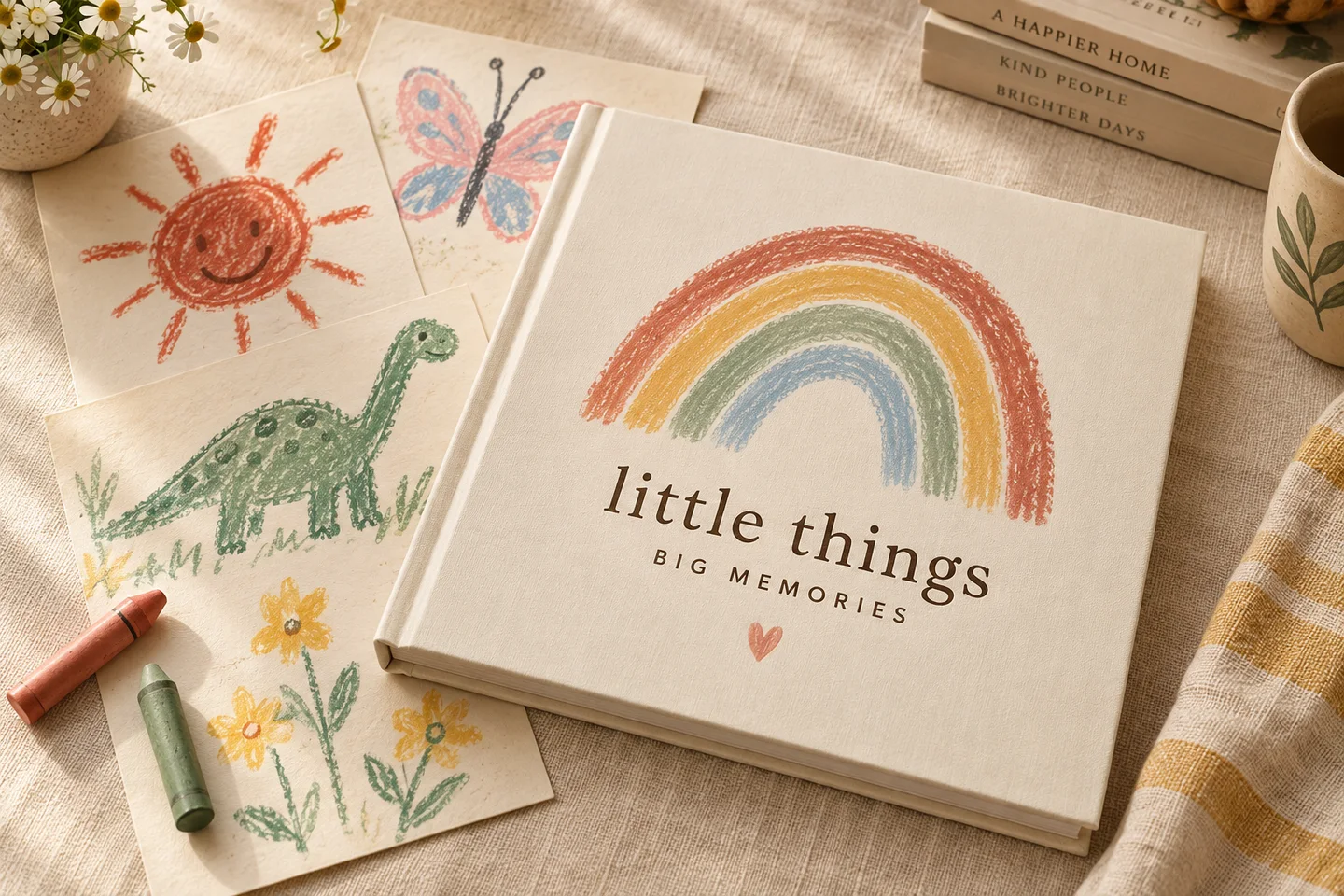
Keeping children’s drawings is not simply an organising problem. A sheet often holds more than an image: a stage of development, an explanation given at the kitchen table, a new way of writing or the first picture made deliberately for someone. That is why a full box does not feel like ordinary waste paper.
Even so, every original does not need to remain forever. The most practical approach has three layers: a small, carefully stored group of originals; good digital images of a broader selection; and something genuinely browsable, such as a yearly book, for the work you want to see again.
Layer one: choose a small original archive
Originals are irreplaceable when material and surface are part of the work. Glitter, thick paint, collage, folding or an unusual paper shape cannot be captured completely in a photograph. A drawing with a particular family story may also deserve to remain on paper.
Instead of choosing an arbitrary number, use one suitable physical container as a natural limit. One archival-quality box per child or period is more helpful than an unlimited series of unsorted cartons. When the box is full, review it; do not simply begin another box by default.
Label a sleeve or loose divider rather than the front of the work. Use pencil on the reverse only when the paper is sturdy and the mark will not affect the image. A full name, address and school do not need to appear on the outside of a storage box.
Layer two: preserve a wider selection digitally
A digital image keeps the visible subject, colour and marks, but it needs a basic quality threshold. Show the whole sheet. Keep light and focus even. Pencil, wax crayon and glossy paint deserve an extra look for glare.
Do not let the photographs disappear straight into an untidy camera roll. Use one temporary folder, then move checked images into private, organised storage. A structure by year or school year is enough. Remove location metadata unless it is a deliberate part of the memory.
If a service claims to support HEIC, PDF or another format, it should genuinely process and check it, not merely list it in the file picker. Keep the original format; a normalised working copy can be useful for layout and preview.
Layer three: make the files visible again
A digital archive is safer than a loose paper pile, yet it may be viewed just as rarely. A Kids’ Art Book gives the collection a considered selection and sequence without forcing everything into a dense collage. Good design lets varied formats breathe, shows pieces at a useful size and keeps captions restrained.
Every page need not look identical. A small drawing may sit with generous white space. A large landscape piece can lead a spread. Two related works may sit together as long as neither is cropped. “Fill the page” is usually the wrong instruction for children’s art: when the proportions differ, a calm border is more honest than a missing part of the image.
What should digital preservation never do?
Children’s art does not need generative “improvement”. Software can correct a tilted photograph, remove a neutral table around the paper and balance the white point conservatively. It should not:
- add or smooth lines;
- make colour stronger by taste;
- invent a missing paper edge;
- replace or complete a subject;
- turn a visible name into an assumed identity;
- guess an age or school year.
Uncertainty needs to be visible too. A blurred or cut-off image should not pass quietly. The customer needs a plain explanation and the choice to replace it, remove it or—only for a warning—keep it deliberately.
Create structure without inventing a story
A book does not need an automatically written family narrative. The work carries enough meaning. A simple structure might use:
- season or school year;
- age, when a parent supplies it;
- a visible title or a short title added by the family;
- material, when known;
- one brief memory in the family’s own words.
“After a rainy afternoon in the garden” is useful when somebody genuinely remembers it. A made-up emotional interpretation is not. A child’s wording can remain verbatim even when its grammar or logic does not match adult expectations.
Privacy is part of preservation
Children’s drawings can include names, school details, addresses or photographs. Keep your digital collection private, and check what appears on a page before sharing it outside the family. Choose a service that explains how your images are stored and how you can delete them.
Analytics also need boundaries. Filename, image content, caption, name and private project address do not belong in marketing or funnel data. Events such as “upload completed” or “blurred image replaced” are sufficient for improving a product without collecting family content.
A small routine you can repeat
- Put new work into one open collection folder.
- Choose a manageable group every two or three months.
- Photograph the digital selection in even light. Use this phone photography guide for a repeatable setup.
- Check the images before letting the paper go.
- Store files privately, organised by period.
- Choose the book selection at the end of the year.
- Keep only the most materially important originals in a suitable box.
The routine can be imperfect. A book with 28 thoughtful pieces is not less valuable because nothing was photographed during one hectic month.
Frequently asked questions
Should I laminate drawings?
Lamination is rarely the best default for an archive. Adhesives and plastics age, create glare and cannot be removed safely. A suitable sleeve or acid-free interleaving sheet is more reversible.
How should I back up the digital images?
Use at least two separate storage locations and occasionally confirm that files still open. A book is an additional viewing object, not a replacement for backing up the high-resolution source files.
What about very large or three-dimensional work?
Take a straight main photograph and add a side view for depth or texture. Important large originals can remain physical. A book does not need to pretend that it replaces every material quality.
Once your selection is photographed, you can see how it becomes a printed Kids’ Art Book with its digital edition included. The pile can become smaller without the work disappearing.