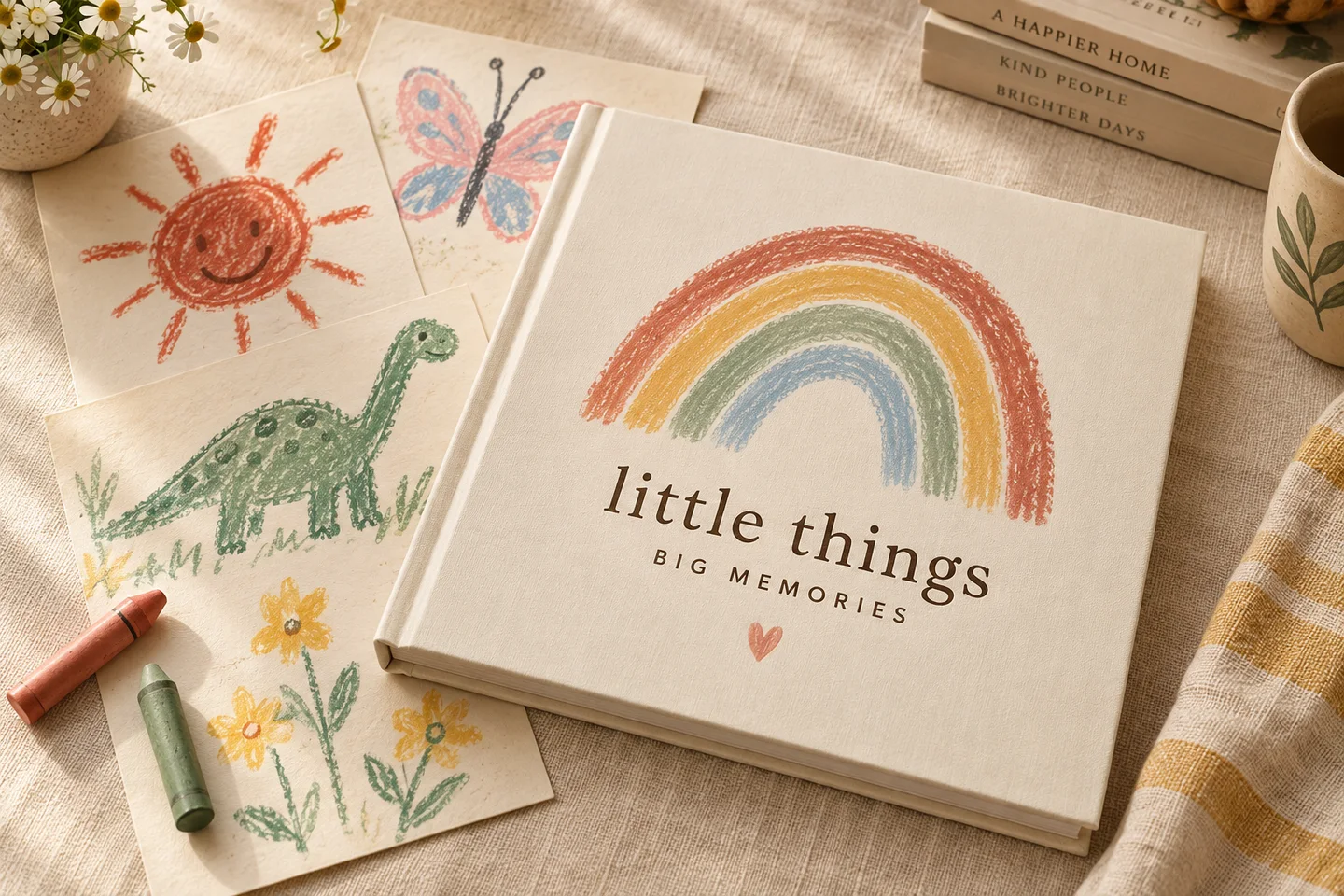
Children’s drawings rarely arrive one at a time. They arrive as a week’s output from nursery or school, birthday cards, doodles, cut-out figures and enormous sheets with one decisive line across the middle. The pile grows faster than anyone can sort it. Throwing it away can feel surprisingly personal.
The answer is not to treat every sheet equally. A useful system separates the moment, the work and the paper. The moment may matter even when the paper does not need to remain forever. The work can be preserved in a photograph. A smaller set of originals can, of course, stay in the memory box.
Do not begin with “What can I throw away?”
That question turns every drawing into a small test. Begin with three positive categories instead:
- Keep the original: work with special texture, family meaning or a story that a photograph cannot fully carry.
- Preserve digitally: drawings whose image, colour or stage of development matters, although the sheet itself need not stay.
- Enjoy for the moment: quick exercises, copies, unfinished attempts and pieces where the making mattered more than the result.
The third group is not a judgement. Not every exercise is meant to become an archive item. Children often make freely and quickly without expecting every mark to last for decades.
Sort in short, defined sessions
Do not begin with the whole loft. Work through one month, one school folder or one drawer. Twenty or thirty minutes is enough. Make three physical areas for the categories and decide at a reasonable pace. If one sheet takes more than a minute, place it temporarily in “preserve digitally”.
A clear period also helps a future book. “Spring in the first school year” makes a more tangible chapter than an uncertain five-year collection. You do not need every exact date. A month, season or school year is often enough, provided you confirm it rather than asking software to guess from the image.
Involve children in an age-appropriate way
Some children want to keep every drawing; others let go easily. Avoid the trap of asking, “Is this really important to you?” Invite a small selection instead: “Which three pictures from this folder would you show someone?” or “Which drawing has the funniest story?”
You can keep two selection threads: the child’s favourites and the adults’ favourites. Both can appear in the finished book. A quiet-looking sheet may represent a developmental change to a parent, while the child prefers a colourful fantasy scene.
Respect a clear no. An organising system should create confidence, not turn hidden decluttering into a problem of trust.
Preserve development, not only polish
If you keep only the “best” work, the result becomes a portfolio rather than a memory. A more interesting collection includes:
- early figures and later, more detailed people;
- a recurring subject across several months;
- something the child felt especially proud of;
- experiments with a new material;
- a drawing with visible early writing;
- two very different pieces from the same week;
- an unfinished work with a memorable explanation.
A Kids’ Art Book works best when it does not feel like a performance review. It records personality and change. You probably do not need ten near-identical rainbows. One or two can stand for that phase.
Photograph first; decide about the paper later
If you photograph while sorting, you do not need to make the final paper decision on the same day. Place photographed sheets in a dated holding box. Once you have checked the images and not reached for the originals for a few weeks, letting go often feels easier.
Do not rely on an unchecked camera roll. Make sure the complete sheet is visible, the image is sharp and the colour is plausible. How to photograph children’s artwork with your phone gives you a repeatable setup.
Avoid creating a digital paper pile
A hundred photographs in the camera roll solve only half the problem. Give the digital collection some form. A simple folder structure may be enough:
Children's art / 2026 / Spring
Avoid filenames containing a full name, date of birth and school when files will be shared or stored in an uncertain service. Family material belongs in private storage. Remove location metadata from phone photographs unless you deliberately need it.
The collection becomes more useful when a book gives it a fixed selection and order. The book is not a public gallery. It is a private object to look through together and, perhaps, give to grandparents.
A realistic yearly routine
A system needs to fit ordinary family life:
- As work arrives: place it in one open collection folder.
- Every two or three months: spend twenty minutes sorting into three groups.
- After sorting: photograph the digital group in one consistent setup.
- At the end of the school year: review favourites and add a title or short memory.
- Once a year: close one book or one clearly organised digital archive.
Large originals, canvases and work with meaningful texture can remain physical. The goal is not a paper-free childhood. It is a manageable relationship between everyday creativity and long-term memory.
What can happen to the paper afterwards?
Clean, uncoated paper may go into paper recycling, depending on local rules. Work with heavy glue, glitter, foil or plastic may need general waste. Some sheets can become wrapping paper, envelopes or craft material, but only when that does not create a new “use it one day” pile.
Do not discard work carrying a visible full name or address without thought. Remove or tear through identifying details first.
Frequently asked questions
How many drawings belong in a yearly book?
There is no ideal number. For many families, 25 to 50 pieces feel generous without becoming exhausting to browse. What matters is giving each work enough space rather than shrinking everything into dense collages.
Does every child need a separate book?
Not necessarily. A family yearbook can work when authorship is labelled clearly. A separate book gives one child’s development more room. Names should come only from information you supply, never from face recognition or guessed relationships.
What if I am not ready to let go?
Photograph the work, check the files and use a dated holding box. A decision in two months is still a decision. The system should relieve pressure, not create it.
Begin with one folder. Keep five originals, photograph ten more and allow the rest simply to have been part of a creative childhood. If you want to turn the selection into a calm physical archive, see how a Kids’ Art Book can give each piece room.